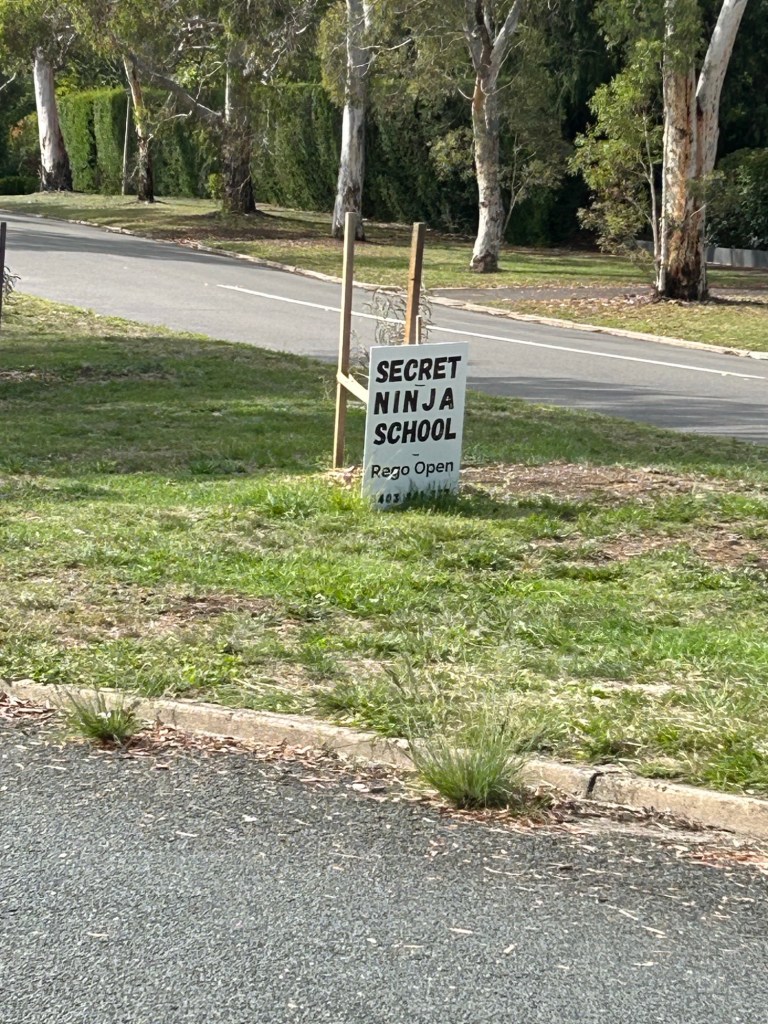
Mugga Way, this morning.
I have questions.
Is it a school for learning how to be a secret ninja?
“High Court judge by day, ninja by night.”
(Be afraid.)
Or is it the school that is secret: a secret school for ninja?
(If it is the latter, they really ought to rethink their strategy: putting out a sign on a major thoroughfare is not the way to maintain secrecy.)
From the sign – which is all the evidence we have – there is no way of knowing which is correct.
(I suppose that might be the point: “if you know you know”.)
Which brings us to hyphens. Specifically, adjectival hyphens. Sometimes they are important. Sometimes they are the only thing separating a “secret-ninja school” from a “secret ninja school”. As (un)punctuated, that sign is advertising a secret school for ninja. That may or may not be correct. In emoji terms: 🤷.
Pivoting to the only subject I know anything about, my approach to proofing judgments is to watch what the judge is doing and largely to leave hyphens as they have fallen (or not fallen); rather than engage with them on first principles, I try to find some kind of pattern and limit myself to making sure the judge stays within their chosen lane.
Of course, the lane may not have been consciously chosen. In my experience, most judges aren’t sticklers for hyphens. Some judges deliberately don’t use them. Others might put one in when they turn their mind to it, but they may not always turn their mind to it. Sometimes, against my better judgment, the easiest path is to take a couple of hyphens out in order to more closely match what has been done across the rest of the judgment. Consistency, on that approach, is more important than technically correct usage.
But this sign makes a useful point: sometimes, when you have two adjectives qualifying a noun, the presence or absence of a hyphen can change the meaning of the phrase.
Often enough the intended meaning will be obvious: nobody needs a hyphen in “industrial relations legislation” or “workers compensation scheme”. I would probably lean towards a hyphen in “class action litigation”, because that isn’t quite as common a phrase, but I can’t imagine that anyone seeing that in a judgment would be in any doubt as to what is being referred to.
But there are other phrases – “secret ninja school”, for example – whose meaning might be entirely unclear. Here, the surrounding context might be all the reader has to go on.
What do I mean?
If the reader can see that the author (or, ahem, their editor) has been studiously applying adjectival hyphens wherever they should be applied, the reader can have confidence that the lack of a hyphen is deliberate. In this way, that sign could confidently be read as referring to a secret school for ninja, not a school for secret ninja.
On the other hand, if the text is devoid of adjectival hyphens for as far as the eye can see, the reader will have no confidence in making a call one way or the other.
(Of course, we will never know what that sign was trying to convey. There is no context.)
The point being: maybe I have been wrong all along. Maybe I should be on a crusade about this, and forcing (scil, “encouraging”) the judges I work for to use hyphens where required, lest “secret ninja school” – or something similarly ambiguous – appear in a judgment where hyphens have not been adopted elsewhere, or have been adopted on an ad hoc (or “random”) basis.
I’m not (yet) having an existential crisis about this. But it has given me something to think about that I wasn’t expecting when I woke up this morning. Curse you, secret ninja school.
…
In the meantime, here is a picture of our own secret ninja. You’re welcome.


 What is the 'it'?
Leave a comment