Your judge wants to cite the case of Re Lehrer and the Real Property Act – or, for that matter, any case reported in the State Reports of New South Wales between 1956 and 1963.
Re Lehrer is a 1960 decision of the New South Wales Supreme Court. The judge has found a reference to it in another case which cites it as “(1960) 61 SR (NSW) 365”. That seems, on the face of it, like a reasonable citation.
But you have in the back of your mind an idea that there is something screwy about some older New South Wales law reports – perhaps you read about it in a book 😎 – so you decide to have a dig around.
The High Court is probably as good a place to start as any.
There is a High Court case of Jennings Construction Ltd v Burgundy Royale Investments [No 2] which cites Re Lehrer as (1960) 61 SR (NSW) 365.
The High Court also cites it that way in Risk v Northern Territory.
My approach with this kind of question is to see how it is dealt with in the local jurisdiction (in this case New South Wales). It is cited as (1960) 61 SR (NSW) 365 in the New South Wales Supreme Court decision of Bondi Beach Astra Retirement Village Pty Ltd v Assem as well as in the New South Wales Court of Appeal’s published judgment in the case of Canada Bay Council v Bonaccorso Pty Ltd.
This is where it gets interesting, though: the New South Wales Law Reports, when publishing the “authorised” report of Canada Bay, changed the citation to [1961] SR (NSW) 365 – which, for what it’s worth, is also how it is cited in the judgment of the Court of Appeal of Western Australia in the Oz Minerals case.
And if you were to look the case up on the online citators from the two big legal publishers in this country (Westlaw and Lexis), you will see that one uses (1960) 61 SR (NSW) 365 and the other has it as [1961] SR (NSW) 365.
What is a poor judge’s associate to do?
The ultimate cause of this fiasco is pretty easy to uncover. From its inception until 1955 the State Reports of New South Wales were consecutively numbered by volume, from volume 1 to volume 55. In what must have seemed like a good idea at the time, from 1956 the reports were published in unnumbered annual volumes until 1964, when (a) I was born and (b) (and perhaps more relevantly) consecutive volume numbering was recommenced. When this occurred, the next numbered volume was not published as volume 56 but as volume 64. This, conveniently, reflected the number of intervening unnumbered annual volumes of the report, of which there were eight – one per year. And the consequence of this was that it became possible, in a seemingly benign form of historical revisionism, to pretend that this eight-year interregnum never happened, and to retrospectively allocate volume numbers to the putative volumes 56 to 63. If we take Re Lehrer as representative (it may or may not be; I don’t have time to do all your research for you), it seems that the New South Wales Supreme Court itself has engaged in that exercise of historical revisionism (as has one of the big publishing houses), whereas the New South Wales Law Reports – which is the direct successor to the State Reports – has not (and nor has the other big publishing house).
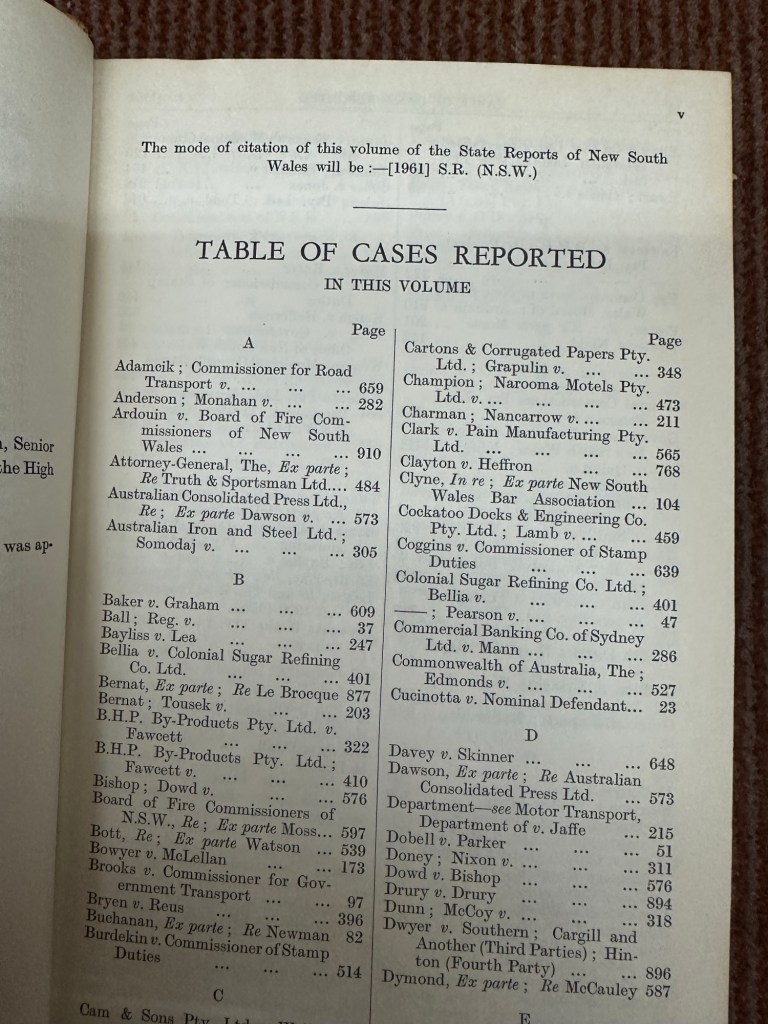
Now, I like things to have one clear and definitive answer. It’s why I enjoy probably 99 per cent of my job. But sometimes I have to acknowledge that there is no right or wrong answer. And this, I think, is one of those times. On the face of things, [1961] SR (NSW) 365 is arguably the “correct” citation. There is even a notation to that effect at the top of the Table of Cases for the 1961 volume of the report. (See the surreptitiously taken photograph below. Keen eyes will notice the High Court carpet in the background.)
But it would be a Herculean feat of intransigence, in 2025, to try to hold fast against the march of revisionist history. I’m not that strong.
In short: if your judge wants to cite Re Lehrer as (1960) 61 SR (NSW) 365, that’s fine. A reader will be able to find it using that citation. If your judge wants to cite it as [1961] SR (NSW) 365, well, that’s obviously fine too.
Can they cite it as “[1960] SR (NSW) 365”? Instinctively that might feel like a reasonable thing to do, given that Re Lehrer is a 1960 decision. But, as you (and your judge) should have learnt at law school, use of square brackets signifies the year of the report, not the year of the decision, and a citation of [1960] SR (NSW) 365 is going to send the reader to the 1960 volume of the State Reports – where the reader will not find Re Lehrer, because Re Lehrer is in the 1961 volume. In other words, no they can’t.
And in case you were wondering, no, I don’t know why signing off on one footnote should be this difficult.

 What is the 'it'?
Leave a comment