
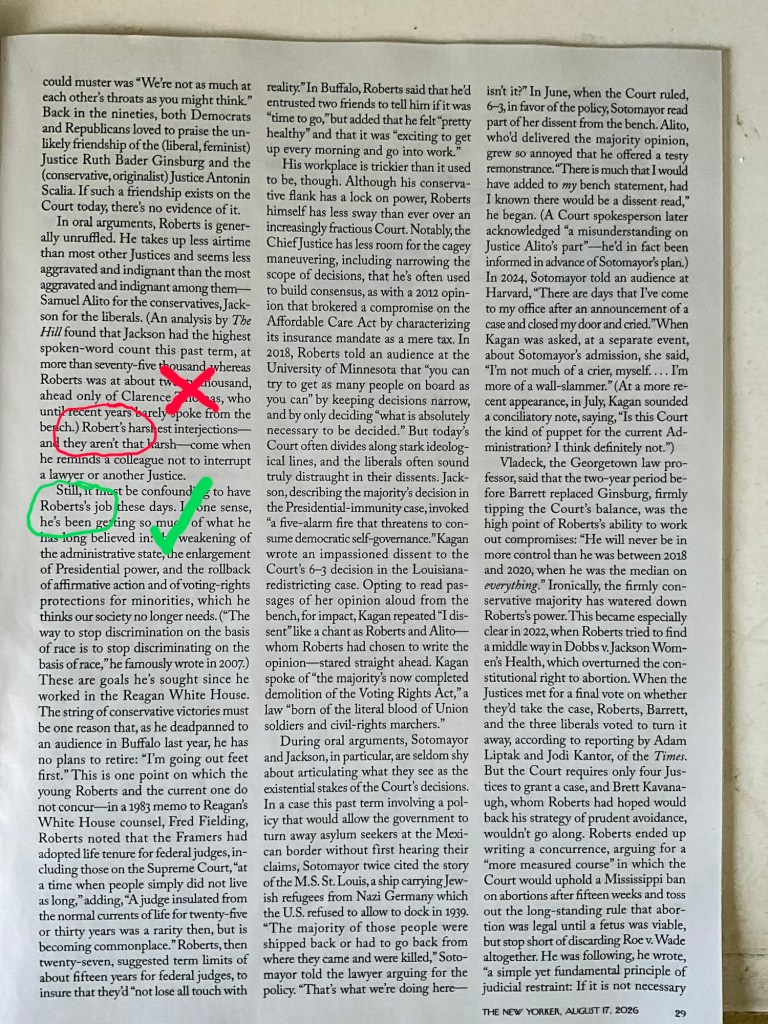
The chances of finding an error in the New Yorker are vanishingly small – once every few years, in my experience (and I am a cover-to-cover New Yorker reader).
But it was with no sense of joy – no “gotcha” – that I discovered in its pages the mistake highlighted above. Far from it. The magazine has long had an admirably rigorous and exacting approach to getting things right. Respect.
This error (from a profile piece on John Roberts, the Chief Justice of the United States) is worth a second look, because it sits at the intersection of three of my favourite things: the New Yorker; the law; and the misuse of apostrophes.
This particular apostrophic failure falls within an area that some judges (and/or judges’ associates) seem to struggle with: the possessive apostrophe attaching to (a) a name ending in “s”; (b) a plural; or (c) both of the above.
I’m sure I have talked about this before. But turning the magazine’s misfortune to advantage, now might be an opportune moment for a refresher course.
Let’s start with the low-hanging fruit: the Chief Justice’s name is “Roberts”. The possessive of Roberts is Roberts’s. It is Roberts’s court. It is not Robert’s court. (It might well be, and it is often referred to as, “the Roberts court”, but that isn’t a possessive.) This is what the New Yorker got wrong. Whoever edited the article would, of course, have known what it should have said. Their mistake was sliding their eye too quickly over the word, “Roberts’s” having appeared numerous times already. That’s not laziness, more a sort of editorial complacency: “I have seen this word already, and it has been right each time; I’m sure this one will also be fine.” Wrong.
The only potential variable is whether or not to include that “s” after the apostrophe. Notwithstanding the strong views that can be held on this topic, this is really a matter of personal preference. I have included it because that’s the kind of guy I am.
From here we move to a more difficult question: what if we are talking about Chief Justice Roberts and Mrs Roberts? Are they “the Roberts”? They are not. Mr and Mrs Robert would be the Roberts. Chief Justice Roberts and Mrs Roberts are the Robertses.
And now we get to the billion-dollar question: what if we are talking about something belonging to Chief Justice Roberts and Mrs Roberts together? Let’s say we are talking about money. Their money is the Robertses’ money. That is a plural possessive. Plural possessives are hard. Or are they? If you understand the previous point – that together they are the Robertses – then literally all you need to do for the plural possessive is stick an apostrophe at the end of it. (And unlike the singular possessive, ie “Roberts’s”, nobody in their right mind is going to try to add an “s” after Robertses’.)
But what about a name that doesn’t end in “s”? What about, say, “Alito”? If Alito had a court, it would be described as “Alito’s court”. That is simple enough.
If something – let’s say a flag – belonged to Mrs Alito, it would be Mrs Alito’s flag.
But what if the flag belonged to both of them? It would be the Alitos’ flag. It would not be “the Alito’s flag”, because they are the Alitos, they are not “the Alito”.
In other words, like the Robertses, turning the Alitos into a plural possessive is no harder than putting an apostrophe at the end.
(In terms of the “s”, the Alitos are almost the reverse of the Robertses: the “s” after the singular possessive is, obviously enough, compulsory – it isn’t Alito’ court – whereas, although I wouldn’t write “the Alitos’s”, it is perhaps not absolutely out of the question.)
And that, my friends, is possessive apostrophes. Let us never speak of this again.


Leave a Reply